Labels

Thursday, 18 December 2014

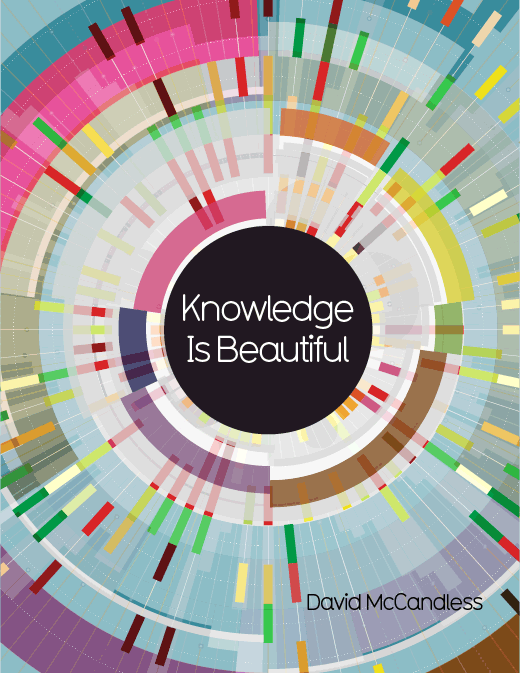
Book Review--Knowledge is Beautiful


I am awed, overwhelmed, intrigued, challenged and critical of this book.


Knowledge is Beautiful by David McCandless is a stunning display of information; each page is packed with the same amount of information found in a chapter or even the entirety of a book.  But all of this information is represented with color, shapes and arrangements to demonstrate, not just the pieces of the facts but also their relationship to each other.

That’s a lot to ask from a bunch of shapes on paper but with the field of infographics, that is the ultimate goal.  Represent as much information as possible with as few words as possible.  Show ratios, proportions and relationships all on a 2D plane.  And David McCandless is a master artist within this medium.

The challenge for me, however, is that I am a very verbal person.  I compulsively read words; signs, subtitles, menus, anything!  So I often look over the illustrations in a book because they don’t have the same impact for me.  This was first challenged when I read the fantastic book The Invention of Hugo Cabret by Brian Selznick which is a wonderful interpretation of the concept of a “graphic novel”.  The detailed illustrations are woven into and tell the story in between the text.  If you don’t “read” the pictures, you can’t really follow the book.  Great practice for me but not quite enough to prepare me for McCandless’ onslaught of pictorial stimulation.

A dizzying array of subjects is offered, loosely separated into four categories which are themselves shuffled like a deck of Vegas cards so that examples from each section are combined, seemingly at random.  Even looking at the table of contents is somewhat confusing when you are trying to find the category for a certain infographic and have to search for the page number because the table is not sequential. When flipping through the book, you will find a graph on the statistical probabilities of things happening to you; a one in “X” chance of correctly guessing a roulette number twice in a row or dying in a car crash driving to buy a Lotto ticket.  The next page features simple sketches of famous people (Jesus and Gandhi at the top) with ratings of their viewpoints along an oppression/progression continuum.  I would advise taking a deep breath before turning pages to prepare yourself for the next assault of information.

That being said, this is chock full of great information, and once understood these facts and relationships are remembered quite vividly because of the visual representations.  I think the key is to have a few guidelines before setting out on the adventure:

  • Remember that each infographic will have its own color scheme and legend of icons
  • First look at the title and read the legend to find out what the colors, images and sizes represent
  • Check to see how many pages a related infographic takes up.  Some only 1, some 2 and some more; there might be page flipping involved
  • Take a deep breath and move your eyes to something neutral in between disparate graphs
  • Take it slowly, trying to read the entire book at once is like trying to listen to 7 college lectures simultaneously on different subjects.
  • Try to appreciate both the informational aspects as well as the conceptual design at the same time


Factoid aficionados will find their match in this densely represented set of information; no quirky sayings, no snarky one-liners to memorize and toss out to unsuspecting bystanders but a satisfying baseline of information on hundreds of different subjects.

Tuesday, 18 November 2014

To Snark or not to Snark... Book Review

Science… for Her! By Megan Amram

--Spoiler Alert—

I didn't like this book.

Now that that’s out of the way, I can tell you why.

Normally, I like satire and sarcasm and snarky comments.  There is an element of danger when putting it in writing, however, because snark doesn't always transfer from speech to text.  This book is an excellent example of how the intelligence and humor from sarcasm can backfire and make the author appear unintelligent, crass, and downright disgusting.

Laid out in a interesting hybrid of science textbook and glossy Cosmo magazine, Science… for Her! starts out visually interesting but the experience goes rapidly downhill from there.  I think part of the problem is that it appears to be one of the current crop of science and math books that presents dry material in fresh, colorful ways to entice potential learners who are anesthetized by the intense graphics of video games and television.  But, as our cataloger will tell you, nowhere in any of the subject tracings (different choices of things that the book is about to help us decide where to put it on the shelf) is there anything relating to science.  This “science” book is filed solely under humor.  But even that is debatable.


I've heard several different sides in the male/female debate about empowerment, male dominant cultures, male bashing, feminism… the list goes on.  But I contend that it doesn't matter your gender or orientation, crude is crude and disgusting has its limits.  There is a point at which humor is lost and it seems as though an author is racing to reach the limits of decency—this one won that race. Whether insulting religion, politics, personal preferences, or just talking about sex, Sex, or SEX, Amram shoots past humorously insulting and aims straight for offensive and disgusting, losing any credibility or reputation for intelligence in the process. 

Book Jacket for: Science...for her!


Agree or disagree?  Join the debate by commenting below...

Monday, 3 November 2014

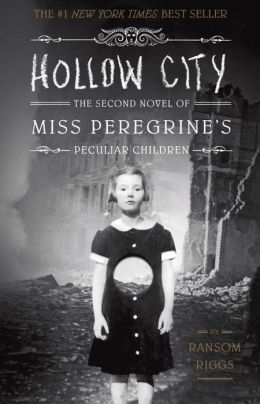
Book Review: Hollow City

Hollow City—The second book of Miss Peregrine’s Peculiar Children by Ransom Riggs

Hollow City: The Second Novel of Miss Peregrine's Peculiar Children

So, ever finish a book and want to throw it across the room?

That was my reaction to Hollow City.  I had eagerly awaited it while it was on hold at the library for me, having finished the first one about a month ago.  I really enjoyed it without expecting to (see review) and was happy to get the second book.

Why violent reaction, you ask?

--Spoiler Alert (kind of)—

Because it’s actually the second book in what is becoming a series!  So while I got excited that the characters were developing and making progress, I neared the end of the book thinking, “Hmm, there seems to be a lack of closure.  Maybe this is one of those books that hits the climax and the resolution is only 1 or two pages.”  But I got closer and closer to the end until *BAM*, the last page sounded the knell of doom: “DON’T LOOK AWAY: The next volume of the Peculiar Children series is coming soon.”

Gaaaah!  I don’t want to have to wait for the next one to find out what is going to happen next because it left on a cliff-hangar.


Oh well, I’ll just have to wait it out until the next one comes out—whenever that is because I can’t find it listed.  The first book was published in 2011 and the second in 2014—I might have some time to wait.

Monday, 22 September 2014

Book Review--Miss Peregrine's Home for Peculiar Children

Miss Peregrine’s Home for Peculiar Children by Ransom Riggs

The first I heard of this book was from my sister who said she got it on her Nook and really enjoyed it, even though it was not her normal genre.  That is a pretty good endorsement to me--if someone enjoys a book despite it being out of their comfort zone.  Then I saw the cover… I know, I know, you’re not supposed to judge a book by its cover. Have you seen it? 


A little odd.  Now, I don’t mind a bit of suspense, a good mystery, fantasy, sci-fi, romance but at first glance this seemed creepy/horror bound.

However, I read the summary and thought interesting.  Then I heard the premise behind how the author developed the story.  Gathering vintage photographs that have no easy explanation (no happy family pictures here… or even awkward family photos) Riggs connected these random images with a story.  Cool, I thought, I make elaborate stories out of just seeing scenes of people at the airport.  So, I tried it.

WONDERFUL!  This does have suspense, mystery and fantasy.  It just skirts the concept of creepy and flirts with horror but never really crosses the line.  The story is solid and the details are vivid and the vintage photos that illustrate the text blend together well.  The only problem is… the next one is checked out and I have to wait!  I’m putting Hollow City: The second novel of Miss Peregrine’s Peculiar Children on hold so I can revisit The Bird and all of her special crew.

Tuesday, 9 September 2014

Book Review--The Disappearing Spoon

The Disappearing Spoon:  and other true tales of madness, love, and the history of the world from the periodic table of the elements by Sam Kean


Ever have to slog through a book to get to the end?  I did recently with The Disappearing Spoon by Sam Kean.  The premise seemed promising—a trek through historical events using the periodic table of the elements as touchstones.  I like science and I’m always looking for ways to peak my interest in history (not my favorite subject) so it seemed like a win-win.  Yeah, not so much.  I really had to force myself through the first half of the book; Kean went into great detail about the initial cosmic distribution of the elements and then into structural analysis of atoms and electrons.  Yes, necessary information to understanding the elements but did it really have to take half the book?  I’m not convinced.


Now, the second half of the book started to get interesting when Kean brought the elements into play during times of war and the great scientific races between countries to discover new elements and classify them in an understandable manner.  But I found it difficult to keep the strings of what he was discussing together because he jumped around from time to country and from scientist to principle with not a lot of tie-in between.  I did find interesting tidbits and the information matches up with what I know about chemistry and physics (more than average but definitely not an expert) but the muddled format was off-putting.


However; I finished, I felt good about it when I was done and now I’m rewarding myself with eye candy… the fun photographic collection of Underwater Dogs by Seth Casteel.  Seeing these canine faces stretched into grins just makes me smile J. 


Tuesday, 10 September 2013

Comparative Review


While I usually like to review books as they stand on their own, I have a pair of books that beg to be compared/contrasted.  I have embarked on a mission to read more of the “classics” and not just current fiction and non-fiction--I blogged my way through Gulliver’s Travels and enjoyed the journey.  My next endeavor is Mary Shelley’s Frankenstein.

I found two different books I thought would be helpful in my quest:  The Western Lit Survival Kit by Sandra Newman and How to Read Literature Like a Professor by Thomas C. Foster.  While they do have different foci (or focuses--you can choose), both of them discuss a wide range of canonical (a lot of educated people agreed these were worthwhile) texts.  They also have different formats but my goal was to learn more about the classic books and how to read them without getting lost, bored, or comatose.


The Western Lit book does have a wider-ranging scope in terms of timeline, spanning the beginning of written stories and ending in the 20th century with William Faulkner.  How to Read Literature takes the approach of different plot devices and how to read the bigger picture.  What I found the most interesting is each author’s voice and approach to the subject matter.

How to Read Literature Like a Professor: A Lively and Entertaining Guide to Reading Between the Lines seemed to me like talking to someone who teaches and enjoys literature and does his best to want you to understand and like it, too.  It was a fairly easy read that still had very interesting content that really made sense and stuck with me.  With just the short introduction, Foster lets you know what he’s doing and how he does it; memory, symbol and pattern are just the mechanics and what follows tells you how these tools are used in understanding stories.  Each of the chapters is a digestible bite of information with lots of examples.  Foster even discusses how the same type of symbol can be used in different ways.  For example, Chapters 2 and 3 discuss eating.  However, Chapter 2 is entitled “Nice to Eat with You: Acts of Communion” and Chapter 3 is “Nice to Eat You: Acts of Vampires”. He brings you out of the actual symbol of eating and into the bigger picture; is this an example of people becoming closer together because they are sharing a meal or is it an example of an unhealthy relationship which drains the life out of another character?  He also explores the Bible and religious connotations, violence, weather, flight, illness and my favorite, irony.  With each section, he brings a lot of examples from different types of stories to support what he’s talking about.  Books are not the only focus, either, he uses short stories, poems and even movies to make is points.  By the time I was done with the book, I felt excited and ready to work on a new book and actively look for the bigger meanings.  According to the bio, Foster is a professor at University of Michigan at Flint and if I were in the area, I’d take a class from him in a heartbeat!

Now, the Western Lit Survival Kit:  An Irreverent Guide to the Classics, from Homer to Faulkner has a completely different tone and doesn’t address irony directly, it employs it liberally throughout the text and dares you to identify it.  The book does what is says and traces the accepted canonical literature from Homer through the 20th century and discusses the general age, the specific authors and chosen texts from each one.  While the sections are informative and contain all the information needed to identify and follow the texts, the major component I wasn’t happy with was the embedded sarcasm.  While I do like irony, sarcasm and the odd cutting remark, this entire book was rife with all of these.  This was less a guide to take you through the literature of the ages and introduce you to great authors and more an inside joke for people who have already read most of the literature and are ready to make jokes nobody else understands.  For the books discussed that I had read, I could understand and almost enjoy the cutting style of writing but for the rest all I could think of was: why did she [Newman] even major in English if these are all such awful books.  I don’t even want to read any of these (except for Gargantua and Pantagruel which was written by a monk in the Renaissance and apparently is a marvel of humor scattering material about theology, natural science and more throughout a story mostly consisting of potty humor, sex and drunkeness.  I am intrigued by how this might be depicted in such a distant society) supposedly classic books.  If you have read many of these books, you will probably enjoy the humor found in these pages.  One helpful tool I did find was the somewhat qualitative measurement of each set of titles according to the importance of the book in the canon, its accessibility for readers, and measurement of fun-ness.

What a difference between two authors discussing literature!

Now, as a post script:  Both of these authors devote chapters to Shakespeare who is reported to be the best of everything when it comes to stories, literature, humor and drama.  Being a modern citizen of the U.S., I have found that Shakespeare requires a lot of work and only some things are worth the effort.  However, I am encouraged by a few helpful tools.  For one, I saw the recorded version of the on-stage production of the Reduced Shakespeare Company which manages to touch on every Shakespeare title in a lively and hilarious 1.5 hours.  And, my next endeavor to introduce the style of Shakespeare to my kids is a book I thumbed through at the airport bookstore: William Shakespeare’s Star Wars by Ian Doescher, “Verily, A New Hope”.  I’ll let you know how that goes when we’re done!


Monday, 18 March 2013

Gulliver's Travels, Part IV and Final

        It's finally time to say "goodbye" to Lemuel Gulliver.  This final entry is partly synoptic and partly interpretation with a dash of opinion thrown in.  I hope you enjoy the recipe.

        Well, our intrepid traveler is at it again.  He is home for only 5 months before he leaves his family... again.  And his wife is pregnant... again.  It has an interesting parallel to the multiple deployments of military members over the past 20 years.  The only thing is that Gulliver is not driven by any other purpose than to satisfy his own itchy foot.

        After the usual contrived episode to get him to the place of his new adventure, he encounters 'animals' which are repulsive to him on any number of levels.  They are sporadically hairy and foul of manners and habits--these details come into play a little bit later.

        Gulliver then comes into contact with the rational ruling population which look suspiciously like horses.  This horse race (heh, heh, no pun intended, maybe) is called "houyhnms" and the spoonerism-like pronunciation is related to 'human' in a somewhat obvious way.

        The houyhnms are as surprised to see him as Gulliver is to see them but he doesn't learn the reason until later.  First he must spend time mastering yet another language, this one based on neighs and snorts.

        For me, I admit, this is where the enjoyment of the story, and the satire, wanes.  As Gulliver describes the supreme rationality and capability of the houyhnms, he simultaneously degrades his own race.  This is mirrored in both the description of humans to his master (who only sees them from his knowledge and perception) and the discovery that the repulsive creatures Gulliver took an instant dislike to are humans, after a fashion.  It's as if all the ugliness of sinful human nature is worn on the outside and dominates the minds of the 'Yahoos' without the veneer of civility.

        It's not just that he takes every opportunity to praise the emotionless rationality of the houyhnms or that he describes the antics of the wild Yahoos in such a negative light that decreases my enjoyment.  It's Gulliver's overwhelming contempt for human life after he returns to his home.  He describes his hatred and disgust for the creatures (even his own family) but he spends the next few years only tolerating them rather than trying to help them understand his new-found zeal for rationality.

        This is where a single reading will not suffice to unpack everything that Swift is trying to say in regards to human nature, passions and the role of rationality in relationships between people.  Or even a divergence into how true converts should be expected to act when confronted with their old life.  Or something completely different.  Or a combination.

        Which leads me to ask you, my reader, how deep do you think we should go?

        Does this book beg a 2nd, 3rd or more reading?

        Does every--or even, any--book deserve that much work?  What would make you decide to give a book a subsequent or more reading?

        Then, how much interpretation do you think comes through the author's intent?  The reader's experience?  Culture or upbringing?  And the ultimate question:

How do you decide if it's worth the extra effort for you?


Next up in the reading list:  The Hunger Games trilogy by Suzanne Collins (no relation)--on AUDIO!

After that:  Information:  A History, A Theory, a Flood by James Gleick (Geek Book Alert)

Next classic:  Up for suggestions.  Peruse the Great Books library list here and give me some options.