Labels

Friday, 17 June 2022

Book Review--Ingredients

 Ingredients: The strange chemistry of what we put in us and on us

by George Zaidan 

Read by the author


"Should I eat the Cheeto?"

This question is the essence of George Zaidan's exploration of the health impacts of ultra-processed foods in Ingredients: The Strange Chemistry of What We Put In Us and On UsUnfortunately, there is no clear cut answer.

I found Zaidan's writing to be very interesting.  He is able to impart true scientific information in such a way that the reader is both entertained and informed--a rare trait.  He refuses to answer his own question outright until he goes through his entire thought process of how to determine 'healthy' versus 'non-healthy' choices.  Again, even this determination is not as easy as it seems as you look at the scope of foods available, what primitive cultures had in the past, how modifications have both helped and harmed the development of food from harvest through processing.

The idea of processing and preserving is a major component in Zaidan's consideration.  We often think of Cheetos and other shelf-stable items as 'processed' or 'ultra-processed' but food processing methods have been utilized for millennia for preservation.  From sun-drying meats and vegetables to salting fish to gathering pre-processed foods like honey, he explores the multiple aspects of preserving foods and how it can impact the health benefits. To introduce the idea, he discusses some real science in how plants feed themselves and then other creatures from aphids which he described as having a 'hypodermic needle-face to cows eating grass to people. This science extends to the battle of fresh foods, decomposition, and the battle against rot to keep food from becoming too dangerous for people to eat.

There is an apparent deviation from the topic of food, preservation, processing, and nutrients but Zaidan introduces another concept of not just what we eat but what we ingest that is not food--tobacco and vaping are discussed in this, as well as put on our bodies--sunscreen features here.  Why is that important?  Because it helps identify the scientific studies that are undergone for information on these and how easily this information can be used, ignored, twisted, or truncated to fit whatever angle is being presented. It also highlights how intricate developing and implementing a solid study can be.

Furthering this idea of the conflicts of scientific studies and how they are presented, he has an entire chapter on the ongoing debate of whether coffee is "the Elixir of Life or the Blood of the Devil". And after lo, these many years, the answer still isn't clear.  Scientific studies are excellent but a single study doesn't tell the whole story or provide a wholly unarguable truth.  So many studies involve on a single aspect of a food to be true to the rigorous aspect of simplicity, unambiguity, and repeatability for other scientists to follow that they only provide pieces to a puzzle that is so vast it's almost impossible to assemble from such tiny details.

That's not to say that scientific studies are of no use, however, they do offer good insights into the nature of the foods under scrutiny and can be judiciously combined with other pieces of information gleaned from other studies to provide practical and valuable information.

After covering all of these things, plus providing some entertaining and/or shocking tidbits, Zaidan concludes with his perspective of whether or not to eat the Cheeto (you have to read it to find out) but also with the realization that his attitude towards food, the food industry, and longevity changed in the investigations he undertook.  Which I think is an excellent example for all of us to follow to be intelligent, well-informed consumers.  Learn as much as you can, compare it to what you know, apply it in a practical manner that fits within your lifestyle and budget and be content that you have done the best you can and will, most likely, continue to enjoy a long life.


End Note: I now have two favorite phrases to use due to Zaidan's lively discourse.
1. Cluster whoops- to denote large, varied, and perpetual mistakes
2. Sciencegasm- to denote the extreme... joy derived by providing wide-ranging valuable and repeatable scientific data.

Wednesday, 8 June 2022

Book to Movie Review

Book to Movie

This is going to be a challenge for me.
I have VIEWS on making movies from books.
These views are not usually charitable. 

In fact, I have been known to get quite passionate in my defense of a beloved story that has been massacred by the movie industry.  The only way I'll consent to reading/watching both interpretations is if I watch the movie first and then enjoy how much better the book is, afterward.  If I read a book beforehand and then watch the movie, I'm vocally (some would say, irrationally) angry at all the changes.

Don't get me wrong, I know there are some reason for changes.  Unless you have a constant voice-over narration, you have to figure out how to get all of the backstory and character thoughts depicted in images.  There have to be changes for format.  However, too often the only characteristics the movie has in common with the book is the title and, perhaps, character names.

But what if you didn't know the movie was based off a book?  What if it was a movie you'd seen dozens of times as a kid and adult and loved? What if you fell in love with the music in the movie? What if, after all these years, you actually read part of the credits to realize there was a book?!

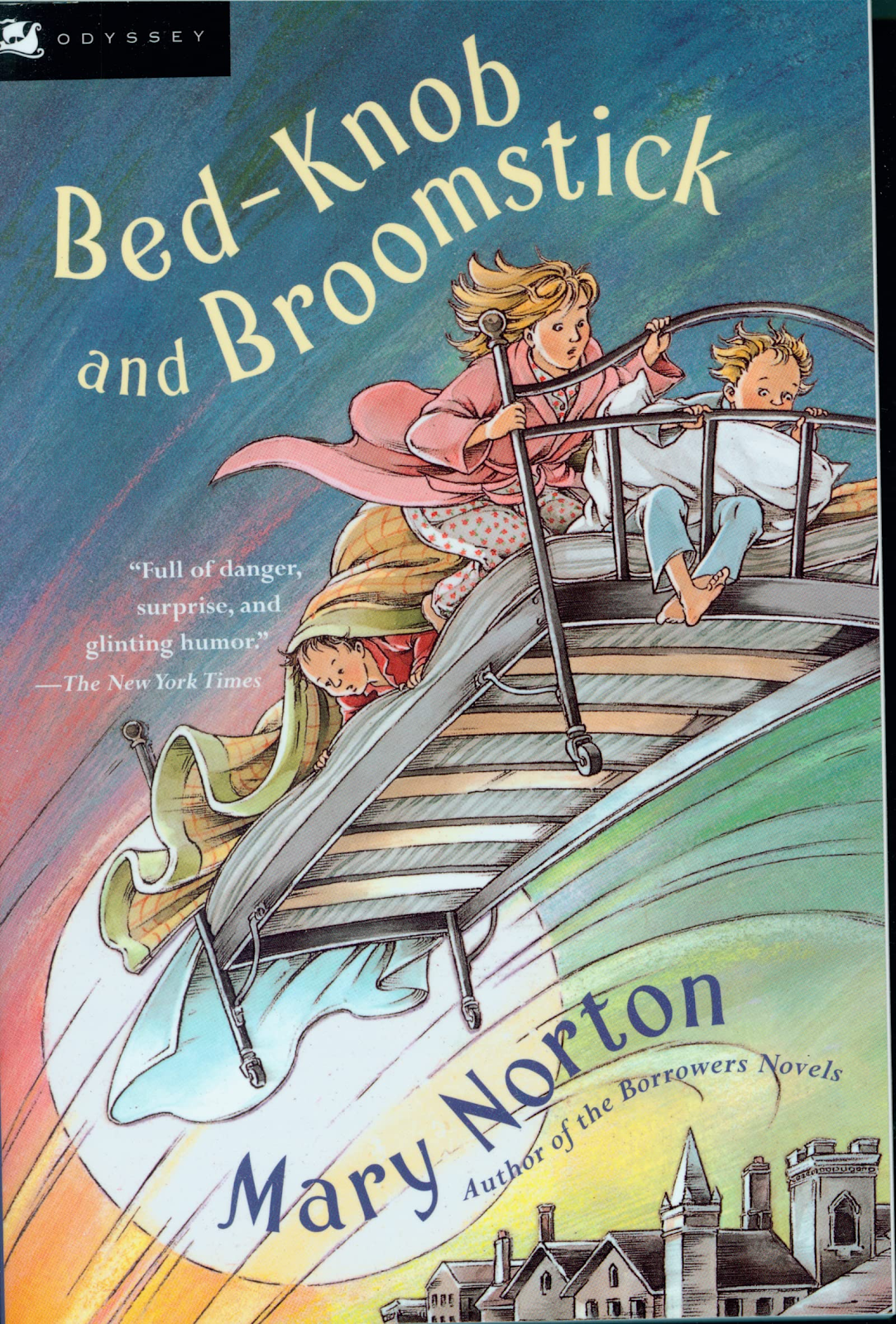
Bedknobs and Broomsticks (by Disney)--I'm looking at you!


Or should I say,
Bed-knob and Broomstick
(singular)
Read by Anna Hassey


I was aware, going in, that this was not going to be a one-for-one translation.  I mean, (cough) Mary Poppins... enough said. (If you haven't read the book series by P.L. Travers, give it a go and you'll see what I mean)

I can see where they got there but the road map has been folded, re-folded, crumpled, sprayed with sea water, torn a bit, burnt and snubbed out, and flattened back out again. True, the character names are the same.  There is a witch--not wicked and not a rich witch, a bed knob, and a bed.  And a love interest named Emelius.  That's pretty much where the similarities end. 


Book

Movie

·         Set in English Countryside

X

X

·         Visit London

X

X

·         Get arrested

X


·         Time Travel

X


·         Jazzy songs


X

·         Island of Naboombu


X

·         Island cannibals

X


·         Love story

X

X


Turns out, I liked them both and was able to appreciate the individuality of each.  I'd like to think of them as cousins that get to see each other at holidays.  Related but not all that closely.

What about you? Do you have a favorite book to movie matchup?  Or one that you are violently opposed to?  Let me know and I'll check it out!


Friday, 13 May 2022

Book Review--On Animals

On Animals
read by the author


"Will brake for animals" is a bumper sticker I need on my car and on my backpack. Whether I'm driving, walking, jogging, or just hanging out in the great outdoors, I will stop in a heartbeat to look at any sort of animal that crosses my field of vision.  Bugs, dogs, birds, worms... I am indiscriminate in my curiosity and adoration.  I will confess to having a preference for mammals, dogs in particular.  But when I live with such beautiful specimens, how could I not be biased?!

Left to right: Pumpkin, myself, Hazel

Ms. Orlean is also a self-confessed animal lover and it shines through in this series of essay-style chapters in her newest book On Animals. She tells us about growing up and wearing her mother down to get a dog and then a mouse (word of caution: don't take your female mouse on playdates with a male mouse) and then detailing the menagerie she has amassed over the years to live a glorious, mildly chaotic life surrounded by animals.

While animal stories can frequently turn into maudlin sentimentality and start reading like Chicken-Free Soup for the Soul, Orlean dodges this trap completely.  She addresses animals as pets, as workers and Hollywood stars, and as spokesmen for the animal kingdom.  Some of the stories have a wistful tone, others are matter-of-fact, and still others will make you chuckle.

This is the perfect on-the-go book as the chapters are self-contained and easily read in small bits when life keeps interrupting.  But if you have an uninterrupted period of time, you can savor each chapter like courses in a fine restaurant and walk away satisfied at time well spent.

Once you have finished this book, I encourage you to switch gears and read The Library Book by Orlean, as well.  I am unashamedly biased in favor of this book because it gives an honest and frank look at libraries and librarianship through the history of the Los Angeles Public Library and the fire that ravaged it in 1986. Definitely worth reading!


Tuesday, 4 January 2022

Book Review: Fitness Series-The Champion's Mind

 The Champion's Mind: How Great Athletes Think, Train, and Thrive

written by Jim Afremow

read by Eric Michael Summerer


I look at high-level competitive athletes with awe, respect, and disbelief at their physical accomplishments.  Olympic events leave me amazed at the capabilities exhibited under so much pressure.  The CrossFit Games leave me breathless as I watch the grueling workouts and think about how exhausted I am after a fraction of the work these amazing people do in a single day. Not to mention all of the fantastical physical feats achieved daily by powerlifters, skateboarders, parkour enthusiasts, climbers, surfers, and all the TikTok-ers that leave me cringing with trepidation at their antics.

By this definition, I am not an athlete.  I am not known for taking chances or stepping out of my comfort zone (I like it there, it's familiar!).  I am also not a competitive person.  I never expect to win a race or finish first in a WOD.  My competition has always been myself; I am only interested in making a better me every day (and, trust me, there's always room for improvement!).

All that being said, there are mindsets that elite athletes have that can be helpful even to regular folks like me.  That is what Dr. Afremow addresses in his book The Champion's Mind.  While focus, dedication, and hard work are some of the things required to make it to the top of a sporting event, these qualities are shared by many others who are not interested in hoisting a trophy over their shoulders but do want to improve their own lives and health.  Afremow gathers stories, tidbits, vignettes, and advice from world renowned athletes and distills them into a handy guide to give insight into what makes the best competitors in the world tick.  The interesting thing is, there is no one single thing that leads to their success.  The ways of looking at the work ethic, practice, and thought process are just as varied as there are people in the world.  Which means you will find something that strikes a chord within you as you read.

I won't ever be a CrossFit games athlete but I can improve my own performance by using some of the aphorisms in The Champion's Mind.  I was pleased to hear it referenced in another book I read (book review forthcoming) Dottir by Katrin Davidsdottir.  I am on the right track to better my own results and be a better me (oblique nod to Ms. Davidsdottir and her motto) if I am training my brain to be just as strong and focused on what success looks like for me as I am on the strength and agility I am trying to augment.

Reading about how so many elite athletes think and work can help you find the champion in yourself!


Tuesday, 7 December 2021

Book Review--Fitness Series: No Sweat

 No Sweat: How the Simple Science of Motivation Can Bring You a Lifetime of Fitness

by Michelle Segar

Read by: Lyndsay Vitale


What motivates you to exercise?

Wait...

What de-motivates you and keeps you from exercising?

This is a great book for those who have tried and failed to "get fit" or "get healthy" or "look better".

If you've tried everything and just cannot stick to a diet and/or exercise plan, Ms. Segar has a few questions for you and will help you explore why it continually fails.

Her stratagem is MAPS

MEANING
AWARENESS
PERMISSION
STRATEGY

First, take a look at what the words exercise, fitness, and health, mean to you. If they all bring to mind misery, starvation, and any other negative connotations, she wants you examine that.  Once you delve into the what those concepts mean to you, that's the first step in defining what doesn't work which will lead you to what DOES work.

This is a very logical and practical look at how society and our own experiences can work together to create, essentially, an unhealthy view of activity and diet.  Learn to find what works for YOU to enjoy an active lifestyle in whatever way works for you.

On a personal note, I have always been an active person (not sporty, mind you, but definitely on the move all the time).  But I have have known so many people who struggle with the mindset that "If I can't run, I won't get fit". Or "I'm not in shape because I hate to lift weights".  I feel that these principles can really reach someone who is in despair about ever being fit because it points out that fitness and the path to it are very personal and it's ok if your path is a different route than anyone else's.  This has been especially apparent since I've started working with athletes as a CrossFit Trainer and I found a lot to relate to my class members from this book.  There are many paths to health and fitness, let Ms. Segar help you find yours.


Wednesday, 10 November 2021

Book Review: Fitness Series--Good to Go

Book Review--Fitness Series 


Good to Go

What the Athlete in All of Us Can Learn from the Strange Science of Recovery

Author: Christie Aschwanden

Audio version read by: Allyson Ryan


As an avid CrossFitter of two years now, I have learned new meanings of the words:

strength

flexibility (or lack thereof)

endurance

fatigue

soreness

Did I mention soreness?  Ohmygoodness!  I may be pushing back the boundaries of my weakness but it can come at a price.  Usually a lot of groans, extra stretching, foam rolling, and audible monologue about "why do I do this to myself?"  But I'm back at it the next day, working harder than ever!

But there are limits. 

Even the most conditioned athletes in the world have to take the time to let their body rest.  Christie Ashwanden takes both a personal and analytical look at the concept of recovery and how it benefits all of us.

How many of these recovery options have you tried? Ice, RICE, heat, Epsom salts, warm bath, naps, stretching, yoga, crying...  I have tried them all, even cryotherapy!


Cryotherapy was definitely invigorating!


Ms. Ashwanden delves into cryotherapy and icing along with a whole host of other common recovery techniques. From massage and meditation to ice baths and compression pants.  Foam rolling and percussion massagers to active recovery runs and beer, the range of options is as wide as the individuality in athletes.  What I appreciated most was that the author delved into the scientific authenticity of each recovery method while calling attention to the difficulty of quantifying what is essentially an individual response to stimuli.  I was intrigued enough to take the plunge in the cold tank so I could make my own decision about how it impacted my own recovery and it opened up questions and possibilities for me to try.

This is worth a read to offer you insights into pop culture cures, general physiological explanations, the dangers of trusting studies without looking into the statistical validity of them, and the overall importance recovery has, no matter how it looks for you.


Tuesday, 14 July 2020

Book Review--Preteniousness

Preteniousness: Why it Matters by Dan Fox

Anticipating and reading this book was a case of "expectation versus reality".


At the risk of looking foolish (not a big risk since I glory in the foolish), let me tell you the thoughts I spun at reading the title and subtitle of this book.

Pretentiousness: Why it Matters.  Ooh, that sounds interesting.  Depending on who I'm with, sometimes people think I'm pretentious because of some of the things I like. Often people are accused of being pretentious because they like things like the theater, art or other things not everyone understands or even enjoys.  But those things are important!  Without art, we wouldn't have beautiful things that many people enjoy, like sculptures, a lovely landscape in a lobby, or a glimpse into another culture.  Without live theater, nobody would learn how to be or think like someone else and learn empathy. I mean, without doing something that someone finds pretentious, nothing would ever be changed!  Of course it matters, I can't wait to read this book.

So.  Now we come to the actual reading of the book.

It starts off with the equation that acting = pretension and goes with that premise; not necessarily taking an in-depth look.  Moves into some other points.  Totally lambastes the fashion industry and then finally starts making sense when getting into art criticism, his field.  (Interesting to note that he never mentions the possible narcissistic aspect of fashion, just it's ephemeral quality).  The odd thing is, the end notes are so long it's confusing why they weren't incorporated into the text.  Since the focus is on how the author came into his career and his background it has a LOT to do with why he's writing about pretentiousness he could have disposed with the mock dissertation style and made it more personal and accessible with the same amount of scholarly knowledge and authority.

Overall, I came away with some interesting thoughts about this view but disappointed in the presentation.