Labels

Wednesday, 23 March 2016

Book Review--The Sweetness at the Bottom of the Pie


The Sweetness at the Bottom of the Pie by Alan Bradley and read by Jayne Entwistle; accessed through OverDrive.

As always, "reading"* a book via audio combines two components; the story itself and the presentation by the reader.

*Disclaimer:  I put reading in "quotes" because it is a different medium than visually reading the printed page.  However, I maintain that any way you get the story into your brain is actually "reading"; it doesn't matter the mode.

Back to the story and our protagonist, Flavia De Luce.  Agatha Christie would applaud the cleverness of this sleuth and Arthur Conan Doyle might have used her to give lessons to Mr. Holmes in deductive reasoning.  And Lemony Snickett would have devised a series of ever-more-unfortunate events for this aspiring detective as she is only 11 years old. Do not automatically discount this as a children's book due to the age of the main character.  Her level of logic, deduction and reasoning will give you pause for thought as it all makes sense... from her point of view.  1950's-era chemistry knowledge and scientific practices, as well as a different views on parenting add to the flair and freedom of this phenom of the mystery genre.

... and I like it because she reminds me of one of my children.

The added bonus of listening to Jayne Entwhistle read was that I enjoyed a crisp accent that reminded me where the book took place (UK) and didn't leave me to wonder at pronunciations.  Ms. Entwhistle gives the text a brisk, matter-of-fact pace that reflects the character's personality wonderfully.

The double bonus is that this is not a new book and there is already a series featuring this fun little girl so I don't have to wait to find out what new adventures await Miss Flavia!


Shameless plug:  I borrowed this book from my public library's OverDrive collection.  Check your local library for access to downloadable audio and e-books!

Wednesday, 2 December 2015

New Book Review--Thing Explainer


Make way for the new best book ever!  Randall Munroe of xkcd and What If? fame has done it again and written a fantastic volume that clearly and not-so-clearly explains how things work, Thing Explainer: Complicated Stuff in Simple Words. My boys and I are in dry-wit geek heaven!

Have you ever talked to a bright 3-year old? They have so many questions and are starting to learn bigger concepts but their vocabulary hasn't caught up with their understanding. So the challenge comes in figuring out how to describe something using words and experiences they can relate to.  I've often enjoyed the comedy of Jim Gaffigan and he has a prime example:

Child: Look, Daddy, a stick.
Dad: It's not a stick it's an antenna.
Child: What's an antenna?
Dad:...Uh... it's a stick.

Here are examples from many years ago with my sons.

Son 1: What are grapes made out of?
Me: Grape guts.
Son 2: What are tongs made out of?
Me: Scissors with no knives.

Sometimes answers come easily and sometimes I'd struggle for explanations and sometimes... total prevarication.

Son: What about...?
Me: Wanna popsicle?

Nowadays, everyone is a bit older and we're interested in different things and our dinner table conversation can include some esoteric subjects (and I should mention we're all Big Bang Theory fans).  Like last night, someone posed the question, "What's the difference between string theory and loop theory?" After a quick search online, I found "String Theory and Loop Quantum Gravity for Dummies" (apropos, I thought) and read about 3 paragraphs.  So we had just enough understanding to pose some questions but not enough to know if the questions were even valid. My daughter's turn, "I think that string theory is the more accurate one because if loop theory were real, light would bend around us and there would be no shadows."  Well.  I guess it's time for Mom to do more research!

But, it really highlights the fact that trying to explain something to someone means you have to really know what you're talking about to help them understand. Who could say it better than Albert Einstein, world renowned physicist and teacher?

"If you can't understand it simply, you don't understand it well enough."

Randall Munroe takes this to a new and humorous level. Using the"ten hundred words in our language that people use the most", he explains the workings of a vast variety of things.  From simple machines that we use everyday;"boxes that make clothes smell better" (washer and dryer) and "writing sticks" (pen and pencil) to things that not many people understand the workings of, "Machine for burning cities" (nuclear bomb) and "big tiny thing hitter" (Large Hadron Collider), we have to make sure we understand for ourselves what makes up these items and processes.  We have to reverse-engineer our own vocabulary to make sure we understand the actual basic contents of the subject.

In the Thing Explainer, you will find the term "tiny bags of water" but you won't see the word "cells".  You'll read about the "big tiny thing hitter" but you won't read the words, "particle accelerator". And this is where the true genius lies.  Vocabulary is important (of course, I'm a librarian, scientist and all-around book-nerd) but not at the expense of understanding.  It's not enough to toss around big words if you don't know the concepts beneath them.  And why not laugh your way through?  So as my kids and I giggle our way through these explanations, we are also making sure we embrace the importance of true understanding.

(And for Big Bang Theory fans, you can consider this the anti-Sheldon book of physics.  Instead of using the biggest words to explain a concept so that nobody can understand it, it uses small words for everyone to enjoy.)

Tuesday, 27 October 2015

Book Review--Mr. Penumbra's 24-Hour Bookstore


I've been wandering through genres since I gave up my old stand-by of historical romance novels (although plenty of family members joked that it was "fantasy", anyway).  And I haven't settled on one particular type of novel that really grabs me and makes me want to read more and more (exception:  Ransom Riggs' Miss Peregrine's Home for Peculiar Children series).  So I've elected a grab-and-try-it approach.

The other factor is that when I'm at my desk in the back of the library (not on the front lines and the reference desk) I have the opportunity to listen to audiobooks while doing some of my more mundane tasks.  So, not only do I have the challenge of finding books that I like but also that the reader is enjoyable, as well.

Ding ding ding

We have a winner!  Mr. Penumbra's 24-Hour Bookstore by Robin Sloan. I was intrigued by the description of the story--featuring a bookstore, libraries, a secretive sect, and typography--and listened to the first 10 minutes of Ari Fliakos' voice interpretation and was hooked!

Set in current times and featuring a cast of characters that aren't afraid to show their geeky side, this journey through the discovery and infiltration of a shadowy literature sect takes some side roads through the Google complex, computers, the history of typography and discusses the possibility of immortality.

Just when you think it's all adventure, interesting characters and not a lot more... in comes the heavy thought of: what would you do to achieve immortality.  And the secondary thought: what does immortality look like to you?  Sloan adds just enough mystery to get you thinking but not so much you feel like you're slogging through a philosophical tome; this story is like chatting with a friend while curled up on the couch. And Fliakos' mellow voice and characterizations bring the story to life in a very satisfying way.

Go ahead, take a chance and visit Mr. Penumbra's Bookstore!

Friday, 16 October 2015

Book Review--Library of Souls


IT'S HERE! IT'S HERE! IT'S HERE!

I've been waiting so long and we finally got it at the library.  I had the first hold on it so I got the first crack of the spine!

(squeal of delight)

Oh.  Sorry, let me compose myself.

--ahem--

I have been impatiently waiting for the third and final installment of Ransom Riggs' Miss Peregrine's Home for Peculiar Children to come out.  And it's finally here!  Library of Souls.


Ooooh, even the title sounds creepy.  And with good reason.  If the first book of Miss Peregrine's dipped its toe in the waters of horror writing, and Hollow City waded in it, Library of Souls plunges you right into to some pretty creepy and horrific things.

The peculiar thing is... I still wouldn't classify this as a horror book; I would call it fantasy.  I think it's because the details and vignettes described aren't done for their shock factor or just to make you shudder.*  They are woven into the story and into the action and into the characters' peculiarities to be an acceptable, if unusual for us "normals", part of that world.

I'm not going to go into the plot points but rest assured that Jacob and Emma and the peculiar gang face enormous challenges in this book.  And if the end almost feels disappointing and flat--it's really just because it means the trilogy is over and it's back to the normal unpeculiar world we inhabit.

Full salute to this wonderful, creepy, awful, fantastic series!  Bird knows when we will ever find another story of this caliber.

http://ransomriggs.tumblr.com/post/125872361717/i-got-my-first-ever-bound-copy-of-library-of-souls

*Caveat: O.K. the two words that made me shudder that you will understand after reading the book: Mother Dust 

Thursday, 8 October 2015

Book Review--Animal Farm


Little wonder this is considered a "classic".

I am slowly working my way through books featured in the Great Books collection and Animal Farm by George Orwell is one of the last entries given in the original list.


Let me begin by saying that I usually shy away from war books and those that deal with a lot of politics.  The latter I don't always understand and the former hurts my heart.

Orwell, as many readers before me have discovered, managed a way to explore the process, psychology and living conditions of governmental upheaval and war without devolving into heart-wrenching graphic depictions that sear pictures into your brain that you can't un-see and un-think.

As an animal lover and dedicated "fur mama", it is easy for me to fall into the personification of animals. I recognize that animals have personalities and their own language so reading an allegory that features them gives me a common ground. But, since I also believe that people are more important* this also give me just a bit of separation so I don't feel the suffering as keenly as I do in books that feature people in horrific situations. So Orwell's use of animals as characters, with people only peripherally in the plot is both accessible and shielded.

I was an oblivious child.  By that, I mean I was cheerful, well-cared for and never needed to think outside of my own little home-school-church triangle.  I was aware of news and some current events in that, I knew big names and some words but since it didn't affect me, I really didn't pay attention to things like the "Cold War" or people like "Gorbachev" they were just concepts floating around my elementary-aged head. But, eventually school and maturity (don't laugh, I've achieved some semblance of it over the years) encroached and I learned about things like communism, socialism, democracy and more. I have even instituted my own form of government at home with my family; my son calls it a "Momarchy". I also hit on some of these topics in various bible studies and discussions over the years, trying to figure out why communism and socialism are almost impossible for humans to maintain indefinitely even if at their heart they seem like good ideas.

But, like many other people, I looked in disbelief on some of the things that happened during those time periods and thought, "How could people let this happen? Don't they see it's wrong?" Animal Farm addresses that concern and more in this allegorical (means a story that means something else) tale. Things don't happen overnight.  There is a gradual build-up and step-by-step acceptance of new things and new ideas.  There is also the element of fear when judiciously wielded by a respected person who comes to power and does not show his nefarious plans in obvious ways. Admit it, things would be easier if bad guys wore black hats, pencil mustaches and chuckled, "heh heh heh" while rubbing their hands together... but it just doesn't work like that.

Reading about the animal members of the community of Animal Farm and sympathizing with their daily lives, talents and limitations, it really brings home how good people can be manipulated into thinking that bad is good and that misery is an acceptable way of life. Human nature is plainly depicted through the animal characters in this powerful book.


*Don't get too riled up about this.  I do believe animals have rights and that humans have an obligation to care for them and their habitats.  But, if there had to be a choice between my children and my dogs, kids and other people come first.

Monday, 8 June 2015

Book Review--Listful Thinking


Confessions of a scatter-brain!

In some circles (not my family) I have the reputation of being organized and on top of things. Whether or not it is completely true is irrelevant, the important thing to know is that it's not natural.

Not that it's unnatural as in bad, just that there are habits I have adopted to help me keep track of important things in life.  I will admit it is often something of a cycle, where I'll be on top of things for quite awhile and then something throws me off my stride and I scramble a bit until I get back to place where I can regroup.  But since I have found techniques that work for me, it's relatively easy to get myself back into the swing of things.

That's what this book can help with.  Listful Thinking by Paula Rizzo explores one of the more powerful tools of organization: lists.  There are dozens of types and styles of lists that you can make and she explores varying formats from notebooks to Post-Its to computer programs.  Understanding the importance of making a list, learning the types that work for your lifestyle and refining how you use them are all addressed in this short, non-threatening book about organizing your life.

Rizzo doesn't urge you to start out by completely overhauling the way you do things or making fundamental changes to your personality; she emphasizes the strengths of each kind of list and introduces ways for you to start using them to streamline your tasks and schedule. She also gives you permission to try and discard the different methods to find one that works for you.  Interspersed throughout the informational narrative are tidbits about famous/successful list-makers as well as reports on studies about memory and the human tendency to want to finish a task.

From sticky notes to digital interfaces, Rizzo offers lots of options and encouragement to find a productive system that works for you to get yourself thinking listfully.

Wednesday, 22 April 2015

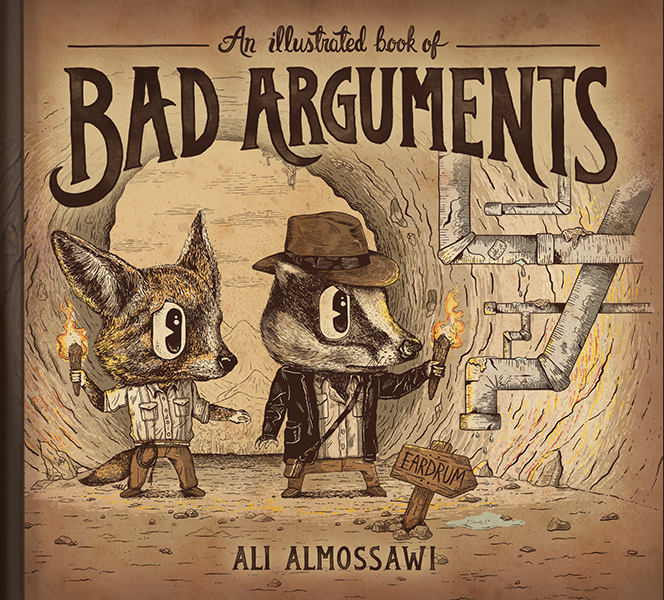
Book Review--An Illustrated Book of Bad Arguments

"Logic does not generate new truths, but rather allows one to evaluate existing chains of thought for consistency and coherence." Ali Almossawi, author of An Illustrated Book of Bad Arguments: Learning the Lost Art of Making Sense.


I liked the simplicity of this explanation which also is reflective of the simple elegance of the text.

Logic when taken as a field of study can be very confusing and, to a novice like me, illogical (that is what we call irony).  Almossawi, however, takes the most common types of arguments and reduces them down to their most basic parts to give an understandable and solid introduction to each type of logic.  Don't be fooled by the whimsical artwork, the cartoons are very good representations of each point and help deepen your understanding with relevant humor.


If you are looking for a place to start in the confusing whirl of logical arguments, An Illustrated Book of Bad Arguments is a good place to gain a foothold.