Labels

Monday, 8 June 2015

Book Review--Listful Thinking


Confessions of a scatter-brain!

In some circles (not my family) I have the reputation of being organized and on top of things. Whether or not it is completely true is irrelevant, the important thing to know is that it's not natural.

Not that it's unnatural as in bad, just that there are habits I have adopted to help me keep track of important things in life.  I will admit it is often something of a cycle, where I'll be on top of things for quite awhile and then something throws me off my stride and I scramble a bit until I get back to place where I can regroup.  But since I have found techniques that work for me, it's relatively easy to get myself back into the swing of things.

That's what this book can help with.  Listful Thinking by Paula Rizzo explores one of the more powerful tools of organization: lists.  There are dozens of types and styles of lists that you can make and she explores varying formats from notebooks to Post-Its to computer programs.  Understanding the importance of making a list, learning the types that work for your lifestyle and refining how you use them are all addressed in this short, non-threatening book about organizing your life.

Rizzo doesn't urge you to start out by completely overhauling the way you do things or making fundamental changes to your personality; she emphasizes the strengths of each kind of list and introduces ways for you to start using them to streamline your tasks and schedule. She also gives you permission to try and discard the different methods to find one that works for you.  Interspersed throughout the informational narrative are tidbits about famous/successful list-makers as well as reports on studies about memory and the human tendency to want to finish a task.

From sticky notes to digital interfaces, Rizzo offers lots of options and encouragement to find a productive system that works for you to get yourself thinking listfully.

Wednesday, 22 April 2015

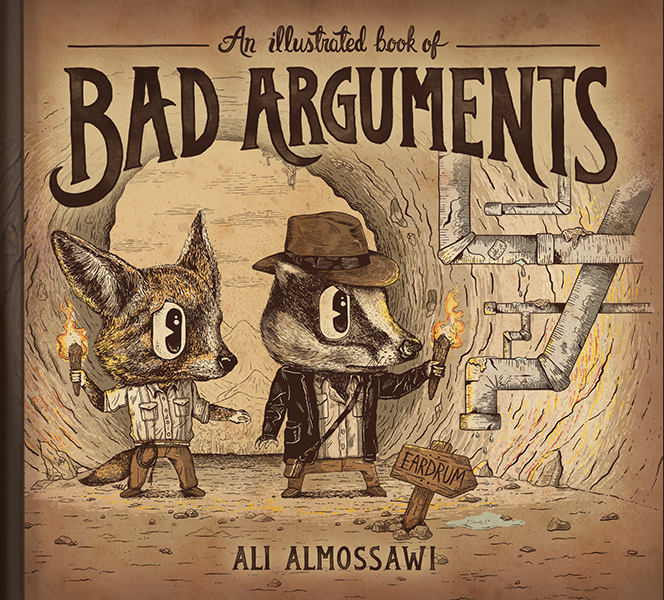
Book Review--An Illustrated Book of Bad Arguments

"Logic does not generate new truths, but rather allows one to evaluate existing chains of thought for consistency and coherence." Ali Almossawi, author of An Illustrated Book of Bad Arguments: Learning the Lost Art of Making Sense.


I liked the simplicity of this explanation which also is reflective of the simple elegance of the text.

Logic when taken as a field of study can be very confusing and, to a novice like me, illogical (that is what we call irony).  Almossawi, however, takes the most common types of arguments and reduces them down to their most basic parts to give an understandable and solid introduction to each type of logic.  Don't be fooled by the whimsical artwork, the cartoons are very good representations of each point and help deepen your understanding with relevant humor.


If you are looking for a place to start in the confusing whirl of logical arguments, An Illustrated Book of Bad Arguments is a good place to gain a foothold.

Tuesday, 31 March 2015

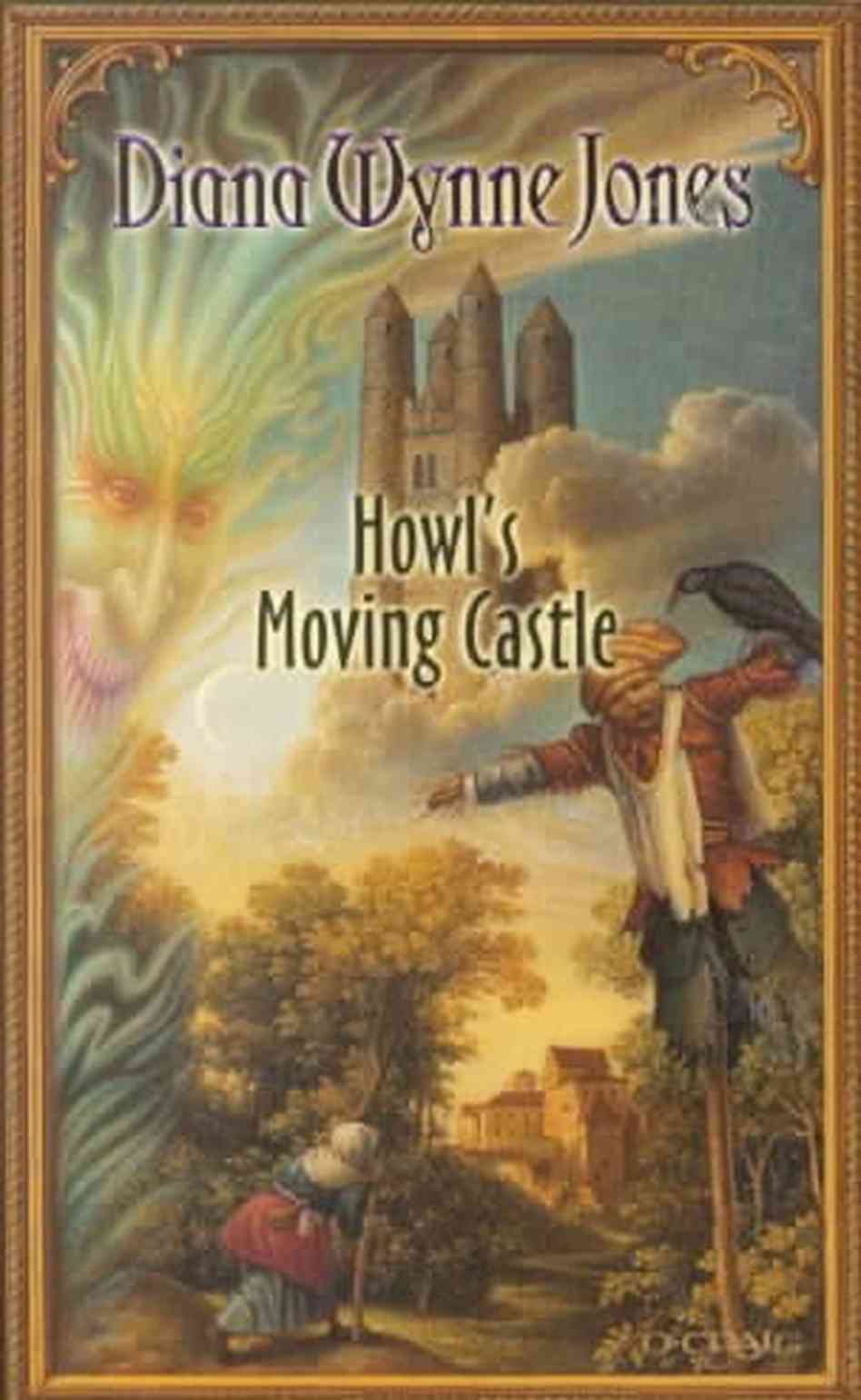
Book Review--Howl's Moving Castle


Every day I miss homeschooling. 
Every day I’m thankful I no longer homeschool.

However, one aspect of what we loved as a homeschooled family has stuck with us even through these past couple of years of formalized schooling.  Reading aloud!  I admit, with working and the kids’ homework and activities, we don’t get to read as often as we used to but we still press on even if it takes longer to finish out the book.

It’s amazing how, even though now my daughter is the one who always requests we read, both the boys will meander in and end up in the same room to listen.  I love to read aloud and they love to listen to stories—it’s a perfect match!

One of our more recent books that everyone thoroughly enjoyed is one of my favorite books, Howl’s Moving Castle* by Diana Wynne Jones.


It’s one of those books that can’t really find a home in the stacks: adult, young adult or juvenile lit. so you should probably check your library catalog to find out where it is in your local library’s collection (and I should mention it's not a new book).  We all enjoyed it, though, and we span all of those categories between the four of us.

This is a fun fantasy with witches and wizards and, as the title suggests, a castle that moves about.  There are adventures and green slime and learning how to like yourself and be content.  And the lesson never to make a contract that includes more than you’re willing to lose. But you’ll meet Sophie, Howl, Michael and Calcifer and be chilled by the Witch of the Waste.  The descriptions are detailed but not bogged down and each character is vivacious enough it was easy to create a recognizable voice and tone for each.

Give it a whirl, you’ll never know what will happen when you set out to find your fortune.


*If you’ve heard of or seen the anime version of this story, please forget all about it and NEVER compare the two.  It’s like looking at before and after pics of celebrity plastic surgery.

Friday, 27 March 2015

Book Review--Real Talk for Real Teachers


If you have ever stepped foot in a classroom as a teacher (or substitute) and felt overwhelmed, Real Talk for Real Teachers by Rafe Esquith has something for you!

I spent the last school year as a substitute teacher in the public school, culminating with the last 12 weeks of the year as a permanent sub for 8th grade Language Arts.  I knew my subject and have a passion for it, I've taught in various informal setting and in small classes at the university level.  But I was not prepared for a classroom of 27 8th graders.  From the horrifyingly frustrating moment when a boy unhooked a girl's bra when we were supposed to be watching the afternoon news program to an irate parent wondering why her daughter didn't get the same grade as another student even though she didn't do the work, I spent many moments treading water, trying to gasp for breath.

That is all behind me currently as I am happily ensconced in my field of education and training: librarianship (although if you're read some of my earlier posts you'll see being in the public library brings its own challenges).  But I believe in learning all I can about any of the various endeavors I try so this book was a wonderful tool to that end.

Grouped into three sections, the beginning teacher, the mature teacher and the experienced teacher, Rafe Esquith addresses the challenges and benefits of each season of a long-term classroom teacher. For newbies, they will find comfort in the reassurance that all great teachers were once new teachers. For the teacher who has settled into his/her stride, encouragement to fight against the comfort of the rut.  And for the experienced teacher who has been at it for decades, the freedom to explore.

Esquith uses a combination of theory, explanation and real-life examples from his own classroom and other interactions he has observed between teachers and students.  Just when I thought he was becoming unrealistically optimistic, he would discuss an obstacle or a failure.  He also does not shy away from the turmoil that politics and standardization have created in the classroom.  Parental interactions are outlined in both the positive and negative.  And very, very frank statements such as "This job can kill you" ensure that new or prospective teachers will know what they are getting in for when they enter the classroom.

If you are even considering a career in education, this is a spectacular book to read to get a realistic account of what being a teacher is.  You will find successes, failures, lesson learned and encouragement in the pages of this gem of wisdom.

Thursday, 18 December 2014

Book Review--Knowledge is Beautiful


I am awed, overwhelmed, intrigued, challenged and critical of this book.


Knowledge is Beautiful by David McCandless is a stunning display of information; each page is packed with the same amount of information found in a chapter or even the entirety of a book.  But all of this information is represented with color, shapes and arrangements to demonstrate, not just the pieces of the facts but also their relationship to each other.

That’s a lot to ask from a bunch of shapes on paper but with the field of infographics, that is the ultimate goal.  Represent as much information as possible with as few words as possible.  Show ratios, proportions and relationships all on a 2D plane.  And David McCandless is a master artist within this medium.

The challenge for me, however, is that I am a very verbal person.  I compulsively read words; signs, subtitles, menus, anything!  So I often look over the illustrations in a book because they don’t have the same impact for me.  This was first challenged when I read the fantastic book The Invention of Hugo Cabret by Brian Selznick which is a wonderful interpretation of the concept of a “graphic novel”.  The detailed illustrations are woven into and tell the story in between the text.  If you don’t “read” the pictures, you can’t really follow the book.  Great practice for me but not quite enough to prepare me for McCandless’ onslaught of pictorial stimulation.

A dizzying array of subjects is offered, loosely separated into four categories which are themselves shuffled like a deck of Vegas cards so that examples from each section are combined, seemingly at random.  Even looking at the table of contents is somewhat confusing when you are trying to find the category for a certain infographic and have to search for the page number because the table is not sequential. When flipping through the book, you will find a graph on the statistical probabilities of things happening to you; a one in “X” chance of correctly guessing a roulette number twice in a row or dying in a car crash driving to buy a Lotto ticket.  The next page features simple sketches of famous people (Jesus and Gandhi at the top) with ratings of their viewpoints along an oppression/progression continuum.  I would advise taking a deep breath before turning pages to prepare yourself for the next assault of information.

That being said, this is chock full of great information, and once understood these facts and relationships are remembered quite vividly because of the visual representations.  I think the key is to have a few guidelines before setting out on the adventure:

  • Remember that each infographic will have its own color scheme and legend of icons
  • First look at the title and read the legend to find out what the colors, images and sizes represent
  • Check to see how many pages a related infographic takes up.  Some only 1, some 2 and some more; there might be page flipping involved
  • Take a deep breath and move your eyes to something neutral in between disparate graphs
  • Take it slowly, trying to read the entire book at once is like trying to listen to 7 college lectures simultaneously on different subjects.
  • Try to appreciate both the informational aspects as well as the conceptual design at the same time


Factoid aficionados will find their match in this densely represented set of information; no quirky sayings, no snarky one-liners to memorize and toss out to unsuspecting bystanders but a satisfying baseline of information on hundreds of different subjects.

Tuesday, 18 November 2014

To Snark or not to Snark... Book Review

Science… for Her! By Megan Amram

--Spoiler Alert—

I didn't like this book.

Now that that’s out of the way, I can tell you why.

Normally, I like satire and sarcasm and snarky comments.  There is an element of danger when putting it in writing, however, because snark doesn't always transfer from speech to text.  This book is an excellent example of how the intelligence and humor from sarcasm can backfire and make the author appear unintelligent, crass, and downright disgusting.

Laid out in a interesting hybrid of science textbook and glossy Cosmo magazine, Science… for Her! starts out visually interesting but the experience goes rapidly downhill from there.  I think part of the problem is that it appears to be one of the current crop of science and math books that presents dry material in fresh, colorful ways to entice potential learners who are anesthetized by the intense graphics of video games and television.  But, as our cataloger will tell you, nowhere in any of the subject tracings (different choices of things that the book is about to help us decide where to put it on the shelf) is there anything relating to science.  This “science” book is filed solely under humor.  But even that is debatable.


I've heard several different sides in the male/female debate about empowerment, male dominant cultures, male bashing, feminism… the list goes on.  But I contend that it doesn't matter your gender or orientation, crude is crude and disgusting has its limits.  There is a point at which humor is lost and it seems as though an author is racing to reach the limits of decency—this one won that race. Whether insulting religion, politics, personal preferences, or just talking about sex, Sex, or SEX, Amram shoots past humorously insulting and aims straight for offensive and disgusting, losing any credibility or reputation for intelligence in the process. 

Book Jacket for: Science...for her!


Agree or disagree?  Join the debate by commenting below...

Monday, 3 November 2014

Book Review: Hollow City

Hollow City—The second book of Miss Peregrine’s Peculiar Children by Ransom Riggs

Hollow City: The Second Novel of Miss Peregrine's Peculiar Children

So, ever finish a book and want to throw it across the room?

That was my reaction to Hollow City.  I had eagerly awaited it while it was on hold at the library for me, having finished the first one about a month ago.  I really enjoyed it without expecting to (see review) and was happy to get the second book.

Why violent reaction, you ask?

--Spoiler Alert (kind of)—

Because it’s actually the second book in what is becoming a series!  So while I got excited that the characters were developing and making progress, I neared the end of the book thinking, “Hmm, there seems to be a lack of closure.  Maybe this is one of those books that hits the climax and the resolution is only 1 or two pages.”  But I got closer and closer to the end until *BAM*, the last page sounded the knell of doom: “DON’T LOOK AWAY: The next volume of the Peculiar Children series is coming soon.”

Gaaaah!  I don’t want to have to wait for the next one to find out what is going to happen next because it left on a cliff-hangar.


Oh well, I’ll just have to wait it out until the next one comes out—whenever that is because I can’t find it listed.  The first book was published in 2011 and the second in 2014—I might have some time to wait.